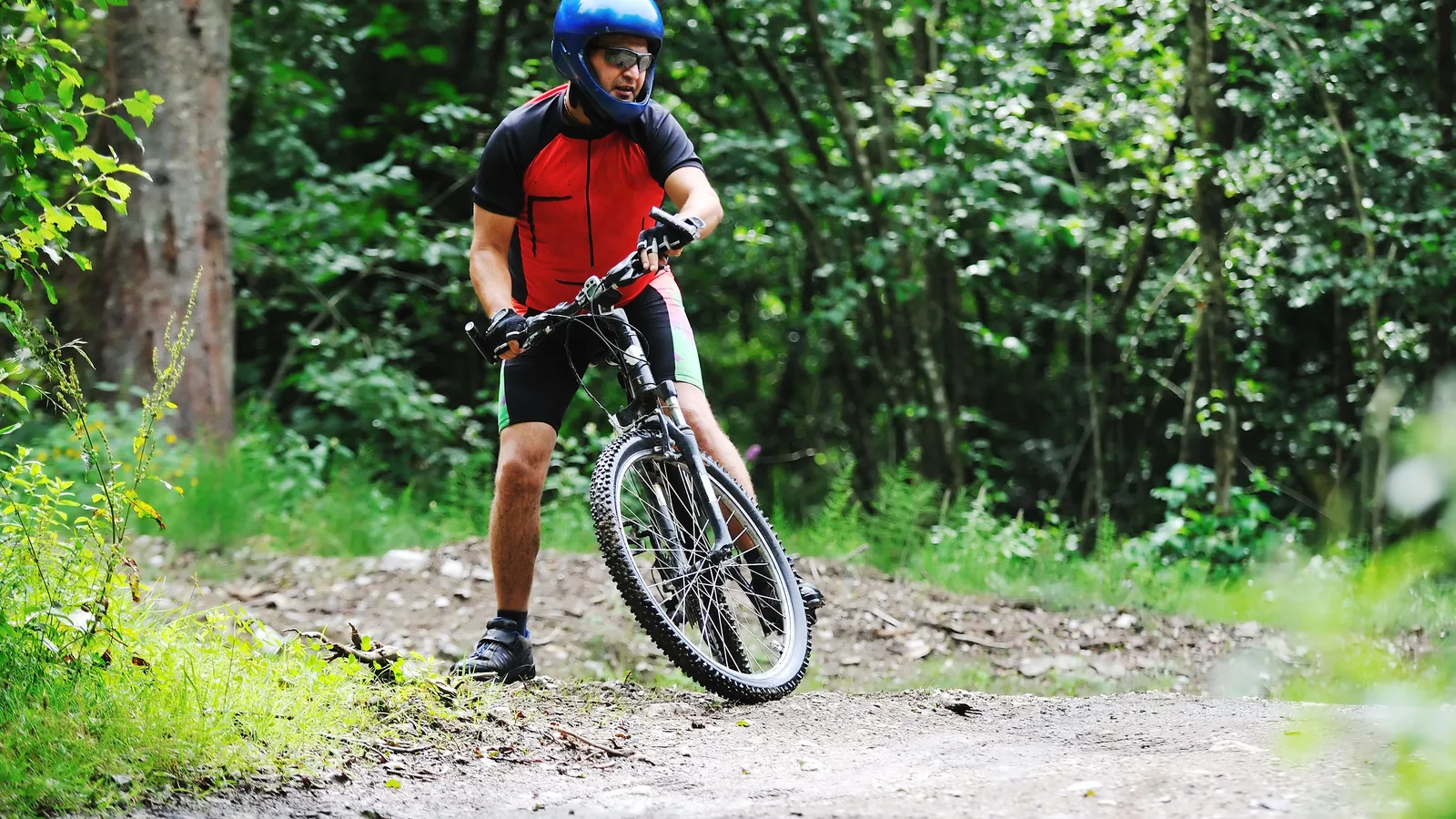
Best mountain bike helmets: 5 picks for UK trail riders
Five mountain bike helmets worth buying in the UK, from a budget MIPS lid to a convertible full-face, plus how to choose one that fits.
The quick answer: which helmet suits which rider
Five helmets, five jobs — start here if you want the short version.
- Best overall: Fox Speedframe Pro — the trail helmet that suits most riders in the UK, from a trail centre lap to a full day in the hills.
- Best budget: Specialized Align II MIPS — a proper trail shape, a dial fit and a slip-plane liner without a big spend.
- Best for aggressive trail and enduro: Troy Lee Designs A3 — deeper coverage at the back and sides for riders who push on descents.
- Best ventilated: Smith Forefront 2 — for hot days, long climbs and riders who overheat easily.
- Best convertible: Bell Super 3R MIPS — open-face for the climb, chin bar for the descent.
The five best mountain bike helmets
All five are open-face or convertible helmets you can pedal in, and all have a retention system you can adjust with one hand. Prices move around with colourways and sales, so shop around; the notes below are about what each helmet is actually like to live with.
Best overall for UK trail riding
Fox Speedframe Pro
4.6If you want one helmet for everything from a midweek evening blast to a long day in the hills, this is it. The Speedframe Pro sits low at the back and wraps the head with a dial retention system, so it stays put when the trail turns rough. The magnetic buckle is easy to fasten in gloves, the visor has enough positions to keep low winter sun out of your eyes, and there's a channel at the back for goggles or glasses. Venting is good for a coverage-focused trail helmet, though it's no XC lid on a long summer climb.
Why it wins
- Deep rear coverage without the bulk of a full enduro helmet
- Dial retention that holds firm on rough descents
- Magnetic buckle is easy to do up in gloves
- Goggle and glasses friendly, with a peak that stays where you put it
What to weigh up
- Costs noticeably more than a basic trail helmet
- Warm on slow, steep climbs in summer
- Pads need washing regularly to stay fresh
Best budget trail helmet
Specialized Align II MIPS
4.2The Align II is the helmet to buy when money is tight but you still want the features that count: a slip-plane liner, a dial you can tighten one-handed, an adjustable visor and a shape that covers more of the back of the head than a cheap road lid. It's heavier and more basic than the pricier picks here, the padding is simple and there's no proper goggle channel at the back — but as a first mountain bike helmet, a spare, or a lid for a fast-growing teenager it makes a lot of sense.
Why it wins
- Slip-plane protection at a budget price
- Easy dial fit and an adjustable visor
- Comfortable on a wide range of head shapes
- Sensible first helmet or second helmet
What to weigh up
- Heavier and less ventilated than premium lids
- No proper goggle strap channel at the back
- Basic padding and finishing
Best for aggressive trail and enduro
Troy Lee Designs A3
4.5The A3 is for riders who spend more time pointing downhill than climbing. Coverage runs deeper at the back and lower at the temples than a typical trail helmet, so it feels closer to an enduro lid while still being comfortable to pedal in. MIPS handles rotation, the visor has three positions and the pads are thick enough for a long day out. It's a big-looking helmet with a big price, and the fit suits rounder heads better than narrow ones — try before you buy.
Why it wins
- Extra coverage at the back and sides
- Comfortable padding for long days
- Three-position visor
- Reassuring on steep, rocky descents
What to weigh up
- Expensive
- Looks and feels bulky on smaller heads
- Better for rounder head shapes than narrow ones
Best ventilated for long climbs
Smith Forefront 2
4.4The Forefront 2 is the pick for anyone who cooks on the climbs. Koroyd tubes and a MIPS liner sit inside a shell with big open vents, and air moves through it in a way most coverage-focused trail helmets can't match. There's a dock for sunglasses and a visor you can raise out of the way on the climb. The trade-offs are real: the honeycomb structure collects mud, dust and the occasional insect, it's expensive, and the fit runs narrower than the Fox or the Specialized.
Why it wins
- Outstanding airflow on long climbs
- Koroyd tubes combined with MIPS
- Sunglasses dock and an adjustable visor
- Comfortable over a full day in the saddle
What to weigh up
- Open honeycomb is fiddly to clean
- Narrower fit than some rivals
- Premium price
Best convertible for bike park days
Bell Super 3R MIPS
4.1The Super 3R is two helmets in one: an open-face trail lid for the ride up, and a helmet with a chin bar for the descents, with the bar clipping on without tools. It's the sensible choice for uplift days, coaching or riders who want more confidence on jump lines without buying a dedicated full-face. In full-face mode it's heavier and warmer than a proper downhill helmet, the chin bar is built for trail riding rather than flat-out downhill racing, and you'll need somewhere to stash the bar on the climb.
Why it wins
- Chin bar clips on without tools
- One helmet for climbing and descending
- MIPS with a well-padded interior
- Great for bike park and uplift trips
What to weigh up
- Heavy and warm with the bar fitted
- Chin bar is for trail use, not downhill racing
- You have to carry or stash the bar on the climb
How the five compare side by side
| Helmet | Best for | Protection | Coverage | Watch out for |
|---|---|---|---|---|
| Fox Speedframe Pro | Trail riders who want one helmet | MIPS and dual-density foam | Deep at the back | Warm on slow climbs |
| Specialized Align II MIPS | A first helmet on a budget | MIPS | Standard trail coverage | Basic padding |
| Troy Lee Designs A3 | Aggressive trail and enduro | MIPS | Deepest at back and sides | Bulky on small heads |
| Smith Forefront 2 | Hot days and long climbs | Koroyd and MIPS | Standard trail, big vents | Fiddly to clean |
| Bell Super 3R MIPS | Bike park and uplift days | MIPS plus detachable chin bar | Extends to the jaw with the bar on | Heavy in full-face mode |
The pattern is simple. Ride mostly undulating trail and the Fox or the Smith will do everything you need. Ride steep, rooty tech most weekends and the A3's coverage is worth the bulk. If your days end with a lift back to the top, the Bell saves you buying two helmets — as long as you accept it isn't a downhill lid.
What actually matters when you buy
Every helmet sold in the UK has to clear the same minimum standard, so the differences worth paying for are the ones you notice on the bike.
- Coverage. The back of the head and the temples are where trail helmets earn their keep. Look at how low the shell comes down at the rear.
- Fit and retention. A dial that wraps the whole head beats a basic ratchet, and pads in different thicknesses help. Try the helmet with your hair the way you actually ride.
- Ventilation. A more open shell means cooler climbs, but also more mud, water and insects inside.
- Visor. An adjustable peak is worth having for low winter sun and for pushing goggles up out of the way.
- Eyewear compatibility. Take your glasses or goggles to the shop — a helmet that pinches the arms of your glasses is unbearable after an hour.
- Weight. You notice it at the end of a long day, but not as much as fit.
- Coverage and protection
- 5.0/5
Rear and side coverage matters as much as the badge on the shell.
- Fit and retention
- 5.0/5
The best helmet is the one that sits still on your head. Everything else is secondary.
- Ventilation
- 3.5/5
Only a dealbreaker if you run hot or climb a lot.
- Weight
- 3.0/5
Noticeable late in a long day, rarely a reason to choose one lid over another.
- Value for money
- 4.0/5
Budget helmets have closed the gap; spend more for coverage, airflow and comfort.
- Living with it
- 3.5/5
Goggle channels, magnetic buckles and washable pads are the details you feel every ride.
MIPS, Koroyd and the rest, in plain English
MIPS (Multi-directional Impact Protection System) is a thin low-friction layer inside the helmet that lets the shell rotate a few millimetres against your head in an angled impact — the kind you get when you land shoulder-first on a root. It's the most common add-on in this list, and it now appears on budget helmets as well as premium ones.
Koroyd works differently: it's a structure of welded tubes, used by Smith, that crushes in a controlled way on impact. Some helmets combine it with MIPS. Other brands use their own versions — SPIN pads at POC, Turbine at Leatt, WaveCel at Bontrager — and they all aim at the same problem.
None of it replaces coverage and fit. A helmet with every technology going but the wrong size is not the safer choice.
- UK and EU helmet standard
- EN 1078 — the minimum every helmet sold here should meet
- Downhill standard
- ASTM F1952 — look for it on full-face helmets
- Speed pedelec standard
- NTA 8776 — tested at higher impact speeds for 45km/h e-bikes
- Impact technologies
- MIPS liners, Koroyd tubes, SPIN pads and Leatt Turbine all aim to manage crash energy
Matching the helmet to your riding
Most British riding sits somewhere between a trail centre loop and a natural bridleway, which is why a trail helmet with deep rear coverage is the default choice. Match the helmet to your hardest regular ride, not your easiest.
- Cross-country and marathon: the lightest, most ventilated open-face helmets with less rear coverage. Fine on fast, smooth courses; less forgiving when it gets steep.
- Trail and all-mountain: the sweet spot for most riders — deep rear coverage, dial fit, a peak you can move.
- Enduro: more coverage, a bigger visor and room for goggles; a convertible starts to make sense here.
- Bike park and uplift days: a full-face or convertible, and if you're riding fast lifted terrain look for ASTM F1952 certification.
- E-bikes: a legal 250W, 15.5mph e-bike is fine with a normal trail helmet; a speed pedelec capable of 45km/h should be paired with a helmet tested to NTA 8776.
Fit and sizing: getting it right
Sizing is by head circumference, measured around the widest part of your head, just above the ears. Most brands cover roughly 51–63cm across their size range, but shapes differ: some are rounder, some narrower front to back. If you're between sizes, try both.
Once it's on:
- The front edge should sit about two fingers' width above your eyebrows, not tipped back.
- The retention dial should be tight enough that the skin on your forehead moves when you rock the helmet, without pressure points.
- The chin strap should sit just under your jaw with the buckle flat, and the splitters should meet just below the ear.
- Push the front of the helmet up and back — it shouldn't move far enough to expose your forehead.
The verdict
Mountain bike helmet FAQs
How often should I replace a helmet if I haven't crashed?
Most manufacturers suggest replacing a helmet every few years, because foam, adhesives and straps degrade with sweat, sun and repeated temperature swings. Store it out of a hot car and replace it sooner if the shell is cracked, the pads no longer hold it steady or the straps have frayed.
Is a more expensive helmet actually safer?
Not automatically. Every helmet sold in the UK has to meet EN 1078 as a minimum, and a well-fitted cheap helmet can protect you as well as an expensive one. Extra money buys deeper coverage, slip-plane technology, better retention, more ventilation and neater finishing — useful, but secondary to fit.
Can I use a mountain bike helmet for commuting?
Yes. There's no legal barrier and the extra coverage and peak are no disadvantage in traffic, though a trail helmet is warmer and heavier than a road helmet and the peak can catch wind when you're tucked down.
Do I need a full-face helmet at a UK trail centre?
Usually not. Most blue and red trails can be ridden in an open-face helmet. A full-face or convertible makes more sense for uplift days, steep jump lines and bike park riding, where speeds and consequences are higher.
Do e-bike riders need a different helmet?
Only if the bike goes beyond the UK's 15.5mph pedal-assist limit. Speed pedelecs capable of 45km/h are typically paired with helmets tested to NTA 8776, which covers higher impact speeds. A normal EN 1078 trail helmet is fine for a legal 250W e-bike.
Are MIPS helmets worth paying extra for?
MIPS adds a low-friction layer that helps manage angled impacts, and it's a reasonable thing to pay for — but it isn't a substitute for coverage and a good fit. Plenty of budget helmets now include it, so you rarely have to choose between MIPS and a sensible price.
Related articles
 Best bike helmets: 5 picks for road, commuting and valueShortlists
 The best bike phone mounts for road and gravel ridersShortlists
 Best Bike Pumps: 5 Picks for Home, Road and TrailShortlists
 Best bike shorts: five picks for comfort on every rideShortlists
 Best BMX Bikes for Street, Park and BeginnersShortlists
 Best foldable electric bikes for UK commutersShortlists
 Best gravel bikes: five picks for UK lanes and club runsShortlists
 Best road bikes: 5 picks for UK ridersShortlists